
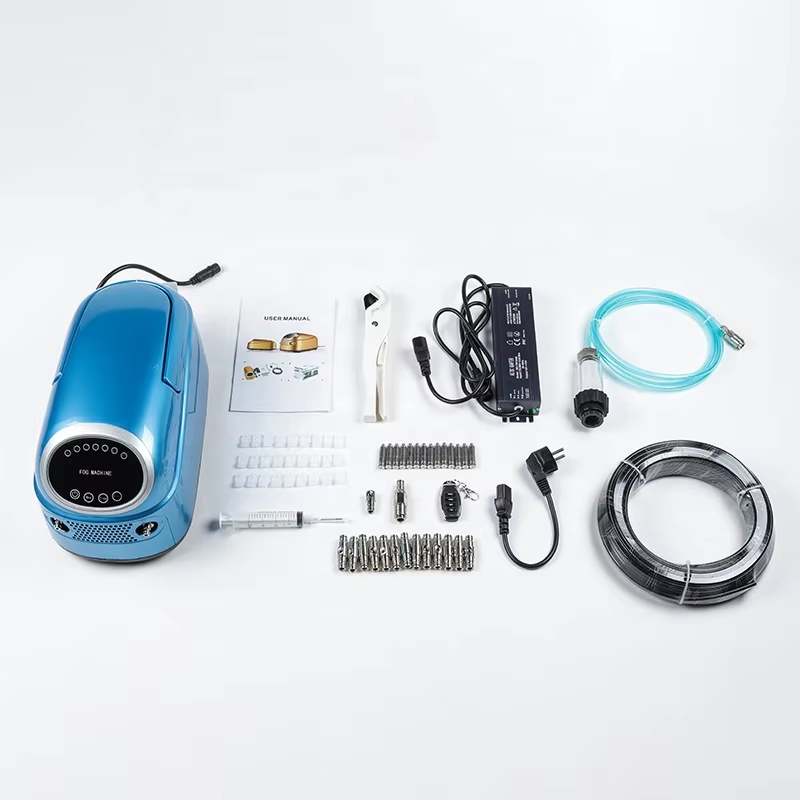
The Science of Evaporative Cooling in Water Mister Systems
How Water Mister Systems Use Evaporative Cooling to Reduce Outdoor Temperatures
Water misters work through evaporative cooling, which is basically when water takes in heat from the surrounding air as it turns from liquid to gas. When water changes states like this, it needs around 1,000 BTUs of energy for every pound that actually evaporates, which helps bring down the temperature around us. The system uses high pressure pumps, usually between 500 to 1,000 PSI, to break water down into tiny droplets. These microscopic water particles have much more surface area exposed to the air, so they can grab heat faster and cool things down quicker than regular sprinklers would manage.
The Role of Fine Mist and Rapid Evaporation in Heat Absorption
The effectiveness of cooling really depends on how small those water droplets are. High quality systems produce mist particles ranging from about 5 to 10 microns, which is roughly 15 times tinier than what we can see with our eyes. These tiny droplets completely evaporate within just two seconds during hot summer days. When this happens so quickly, it stops surfaces from getting wet while pulling maximum heat out of the air around them. The result? Cooling that works at least five times quicker compared to regular sprinkler systems.
Linking Humidity Levels and Cooling Efficiency: Why Dry Air Enhances Performance
The effectiveness of evaporative cooling really shines when the air is dry. Take places where the humidity stays under 40%, for instance. Mist systems there can actually bring down temperatures anywhere from 25 to 30 degrees Fahrenheit because water just evaporates right away without any issues. But things change quite a bit once we hit around 60% humidity or higher. When the air gets too moist, it basically stops evaporation cold. Studies show this can cut system performance by about 70% according to research published by ASHRAE last year. That's why these misting setups work so well in deserts like Arizona. With such little moisture already in the air, almost every drop turns into vapor before hitting the ground.
What Does a Mist Cooling System Actually Do? Separating Perception From Physical Change
While misters physically lower air temperature through evaporation, the perceived cooling often exceeds measured changes. A 15°F actual drop can feel like 25°F due to:
- Evaporative cooling of skin moisture (accounting for ~70% of human heat dissipation)
- Enhanced airflow from integrated fans
- Psychological response to sudden moisture in dry heat
This combination of physical and perceptual effects allows users to feel significantly cooler even when ambient temperature shifts are modest.
Factors Influencing Actual vs. Perceived Cooling
While misters physically cool air, human comfort is shaped by multiple interacting factors:
| Factor | Impact on Cooling | Mitigation Strategy |
|---|---|---|
| Wind speed >8 mph | Disperses mist plume | Install windbreaks |
| Humidity >60% | Slows evaporation rate | Use intermittent mist cycles |
| Direct sunlight | Overpowers cooling effect | Combine with shade structures |
Water Mister Performance in Dry vs. Humid Climates
Why water mister systems excel in arid environments like Phoenix, AZ
Misters work best in really dry areas where the air has less than 40% humidity because the water evaporates so fast. Those tiny 10 micron droplets actually take in around 1,000 BTUs for every gallon that turns into vapor. To put that number in perspective, it's kind of like cooling down 3,200 pounds of air by about 10 degrees Fahrenheit. Some research published on ScienceDirect back in 2024 looked at how misting systems affect body temperature in hot cities. They discovered that in places like Phoenix where it gets super dry, misters can drop skin temperature by roughly half a degree Celsius. That's almost double what happens in more humid locations where the same systems only bring down temperatures by about quarter of a degree.
The comfort paradox: How misters improve perceived coolness even without significant temperature drop
In humid New Orleans, 68% of users report "cooling relief" despite an average temperature change of just 0.5°F. This perceived benefit arises from:
- Windborne mist lowering skin surface temperature (psychrometric effect)
- Air movement creating wind chill
- Visual and sensory cues triggering psychological cooling responses
Key Factors That Optimize Water Mister Effectiveness
Systems running at high pressure above 500 PSI work best when combined with those tiny micro-orifice nozzles. These create droplets smaller than 50 microns which basically disappear while still floating in the air. On the flip side, equipment operating between 40 to 80 PSI tends to make bigger droplets that hit surfaces before they even start to evaporate. When it comes down to it, how well the nozzle is designed counts for more than just having lots of them. Studies indicate that one good quality precision nozzle actually performs as effectively as three regular ones because it breaks liquid into much finer mist particles during atomization process.
Table of Contents
-
The Science of Evaporative Cooling in Water Mister Systems
- How Water Mister Systems Use Evaporative Cooling to Reduce Outdoor Temperatures
- The Role of Fine Mist and Rapid Evaporation in Heat Absorption
- Linking Humidity Levels and Cooling Efficiency: Why Dry Air Enhances Performance
- What Does a Mist Cooling System Actually Do? Separating Perception From Physical Change
- Factors Influencing Actual vs. Perceived Cooling
- Water Mister Performance in Dry vs. Humid Climates