
Coverage Fundamentals: Matching Misting Machine Capacity to 600sqm Commercial Spaces
Why 600sqm Is a Critical Threshold for Commercial Misting Machine Sizing
When dealing with spaces around 600 square meters, home grade misting systems just don't cut it anymore. That's when businesses need to step up to commercial grade equipment. The bigger the area gets, the more intense the cooling requirements become. Restaurants with large outdoor seating areas or event spaces often hit this sweet spot where smaller systems can't handle temperatures pushing past 32 degrees Celsius. Commercial misters need roughly 40 percent more water flow than what residential units offer if they want to cover all corners without leaving hot spots. And let's talk about energy usage too. A well sized commercial system actually runs about 35 percent less than an overworked residential unit trying to do the same job. Makes sense when you think about it - spending a bit more upfront on proper equipment saves money long term while keeping guests comfortable.
Calculating Minimum Flow Rate (GPM) and Pressure (PSI) for Uniform 600sqm Coverage
Optimal system sizing hinges on two core metrics: flow rate (gallons per minute, GPM) and operating pressure (pounds per square inch, PSI). Use these validated formulas:
Minimum GPM = (Area in sqm × 0.16) + (Nozzle Count × 0.25)
Where 0.16 reflects baseline flow demand per sqm, and 0.25 GPM accounts for typical nozzle draw.
Required PSI = 800 + ((70 - Local Avg. RH%) × 50)
This humidity-adjusted formula ensures micro-droplets (10–20μm) penetrate thermal layers without surface saturation.
For example, in a 50% RH environment with 60 nozzles:GPM = (600 × 0.16) + (60 × 0.25) = 96 + 15 = 111 GPMPSI = 800 + ((70 - 50) × 50) = 1,800 PSI
Always cross-check results against nozzle spacing guidelines: 3-meter intervals for perimeter layouts, 4 meters for central zones—ensuring even distribution and avoiding over- or under-cooled areas.
Nozzle Layout and System Design for Optimal 600sqm Mist Distribution
Nozzle Spacing, Density, and Climate-Adjusted Layout Guidelines
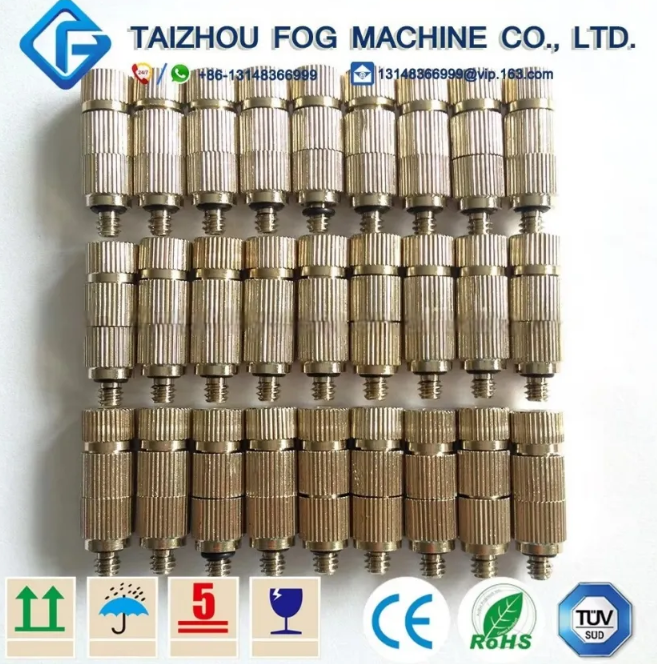
Getting even coverage over 600 square meters isn't simply about having lots of nozzles around it's really about where those nozzles are placed with some engineering know-how. When dealing with outdoor spaces such as patios, we generally recommend putting nozzles approximately two to three feet apart along the edges to create what people call a cooling curtain effect. The actual spacing matters quite a bit depending on local conditions. For dry climates below 40% relative humidity, stretching out to about 30 to 36 inches between nozzles helps avoid getting things too wet. But if the air is already pretty moist over 60% RH then bringing them closer together at 18 to 24 inches works better for faster evaporation. Systems installed higher than nine feet need bigger hole nozzles at least 0.012 inch diameter to combat droplets drifting down before they can do their job. A recent look at thermal images from ASHRAE in 2023 showed something interesting when they concentrated nozzles in busy spots with density increases of 30 to 50%, the whole system became 18 percentage points more efficient compared to spreading everything out evenly.
Empirical Formula: Estimating Nozzle Count Based on Area, Droplet Size (10–20μm), and Humidity
Use this field-validated formula to determine nozzle count for 600sqm:
Nozzle Count = (Area in ft² × Climate Factor) · (Droplet Size Factor × Spacing Density)
| Variable | Arid Climate (<40% RH) | Humid Climate (>60% RH) |
|---|---|---|
| Climate Factor (CF) | 0.85 | 1.15 |
| Droplet Size Factor* | 1.1 (10μm) | 0.9 (20μm) |
| Spacing Density (SD) | 10 ft² per nozzle | 6 ft² per nozzle |
*Droplet size factor adjusts for evaporation kinetics: finer droplets evaporate faster in dry air but linger in humid conditions—requiring proportional density changes.
Example Calculation:
600sqm ≈ 6,458 ft², humid zone, 15μm droplets (interpolated factor ≈ 1.0):(6,458 × 1.15) · (1.0 × 6) ≈ 1,238 nozzles
Sustaining ≥8 GPM total flow remains critical—regardless of climate—to prevent pressure loss across large-scale piping networks.
Selecting the Right Commercial-Grade Misting Machine for 600sqm Applications
High-Pressure vs. Mid-Pressure Misting Machines: Performance Tradeoffs at Scale
When dealing with spaces around 600 square meters for commercial purposes, high pressure systems exceeding 1000 PSI stand out as the best bet for reliability. These systems create extremely fine mist particles under 20 microns in size that disappear almost immediately upon contact with air, providing temperature drops of approximately 25 degrees Fahrenheit without leaving surfaces damp. Mid pressure equipment operating between 250 and 800 PSI simply doesn't cut it in dry climates according to research published in several industry journals. The bigger droplets they produce cut down on cooling effectiveness by roughly 30 to 40 percent compared to high pressure alternatives. Sure, mid pressure options might seem cheaper initially, but problems like mineral deposits building up inside nozzles and uneven spray distribution tend to plague these systems over time, making them impractical for covering entire areas consistently. High pressure models constructed with stainless steel pumping mechanisms and parts resistant to corrosion typically last about half again as long as their counterparts while using significantly less water per square meter. Businesses investing in this technology often see real returns on investment thanks to both extended lifespan and improved operational efficiency.
Key Specifications: Sustaining 8+ GPM at 1,000–1,500 PSI Across Full 600sqm Layout
For a commercial misting system covering around 600 square meters, it's essential that the equipment maintains at least 8 gallons per minute at pressures between 1,000 and 1,500 pounds per square inch throughout all the pipes, not just right at the pump itself. Without proper pressure distribution, those nozzles located furthest away from the main unit tend to underperform significantly. We've seen many installations fail because perimeter areas end up getting only about 60% of what they need for good mist coverage. That's why industrial strength pumps equipped with pressure regulators make such a difference when multiple nozzles turn on at once. Also worth mentioning are the corrosion resistant headers which help maintain steady water flow even after years of operation. When dealing with hot and humid environments like tropical regions, going for somewhere around 1,200 psi becomes necessary to get those tiny droplets below 20 microns that actually evaporate before hitting the ground, making the cooling effect work properly.
Fixed-Line vs. Hybrid Misting Systems: Practical Fit for 600sqm Venues
When looking at commercial spaces around 600 square meters (think patios, outdoor dining spots, event areas), fixed line misting systems are great because they offer lasting coverage through rigid pipes built right into the structure itself. They do need careful planning from day one though, which is why many businesses invest time upfront. But once installed, these systems tend to last forever with hardly any upkeep needed. Some places go for hybrid solutions instead. These mix permanent installations with mobile misters that can be moved around. This works well when layouts change seasonally or when expanding operations temporarily like setting up extra cooling for pop up bars during festivals without disturbing the main seating area's misting system. The downside? Hybrid arrangements mean dealing with trickier plumbing work and getting everything calibrated properly so all components actually work together smoothly.
When making this choice, what matters most is how consistent operations need to be. Fixed line systems cut down on labor costs and maintenance over time when setups stay the same. Hybrid options work better for areas that change around but come with bigger upfront expenses and more complicated management. No matter which setup gets chosen though, there's one non negotiable requirement for these misting machines they need to maintain at least 1000 pounds per square inch pressure along with minimum eight gallons per minute flow rate. This ensures coverage across all 600 square meters without any drop off in performance from the hydraulic system itself.
Table of Contents
- Coverage Fundamentals: Matching Misting Machine Capacity to 600sqm Commercial Spaces
- Nozzle Layout and System Design for Optimal 600sqm Mist Distribution
- Selecting the Right Commercial-Grade Misting Machine for 600sqm Applications
- Fixed-Line vs. Hybrid Misting Systems: Practical Fit for 600sqm Venues