
The Science of Evaporative Cooling in High-Pressure Misting Systems
Understanding Flash Evaporation and Its Role in Rapid Cooling
High pressure misting systems work through what's called flash evaporation. When those super tiny water droplets, around 5 to 10 microns in size, hit the air they basically disappear into vapor almost right away. What happens during this process is pretty interesting - the system pulls heat out of the surrounding environment as it goes. We're talking about something like 970 BTUs being absorbed for every pound of water that turns to steam. The secret sauce here lies in those specialized nozzles operating under intense pressure, roughly 1,000 PSI. This forces water into such small droplets that they have a massive surface area compared to their actual volume. That means things cool down fast without getting anything damp or soggy, which makes these systems so effective in places where moisture would be a problem.
Thermal Dynamics Behind Evaporative Temperature Reduction
Cooling happens because of how heat moves around when water changes states. When water turns from liquid to vapor, it actually pulls warmth out of the air around it. This works really well in arid areas where there's not much moisture already. Some studies show that in these conditions, temperatures can drop as much as 25 degrees Fahrenheit. But getting good results requires careful control over droplet size. If the water particles are too big, they just won't evaporate completely. On the flip side, if they're way too tiny, they disappear before they have a chance to take in enough heat to make a real difference. Finding that sweet spot between too large and too small is what makes the whole process work efficiently.
Why Droplet Size (5–10 Microns) Maximizes Evaporation Efficiency
Particle size critically influences evaporative performance:
- 5–10 micron droplets: Achieve 95% evaporation within 0.5 seconds, striking the ideal balance between surface area and dwell time for outdoor cooling
-
>15 micron droplets: Increase risk of moisture accumulation and diminish cooling capacity
High-pressure pumps and micro-nozzles work together to maintain this optimal range, ensuring efficient heat absorption.
Limitations in High Humidity Environments: When Cooling Effectiveness Decreases
The effectiveness of evaporative cooling relies heavily on how well air can take in moisture, but this gets complicated when humidity levels climb above 60%. When the air starts getting saturated, those water droplets just hang around instead of disappearing into vapor, so the temperature drop typically only reaches between 8 and 12 degrees Fahrenheit at best. Smart cooling systems work around this problem through clever adjustments to their misting schedules and by carefully positioning nozzles where they'll interact most effectively with air movement, which helps maximize how much actual evaporation happens during operation.
High Pressure Operation at 1000 PSI: Enabling Instant Flash Evaporation
How 1000 PSI Pressure Enables Ultra Fine Water Atomization
When running at around 1,000 pounds per square inch, misting systems can push water through those special nozzles and create tiny droplets measuring between 5 to 10 microns. That's actually pretty close to what we need for quick evaporation. The pressure itself gives the water enough kinetic energy to break apart into a fine mist that turns into vapor long before it even touches anything. According to some recent findings by the Cooling Technology Institute back in 2023, these smaller droplets (anything below 15 microns) tend to disappear about four times quicker than bigger ones. And when they evaporate faster, they pull away heat much more effectively too.
Role of Precision Nozzles in Generating Micro-Droplets for Immediate Evaporation
Nozzles designed with tiny openings at the micron level can turn pressurized water into evenly sized microscopic droplets. Regular garden misters typically create droplets larger than 50 microns, but these specialized versions keep their spray pattern stable even when faced with really high pressures. Testing has shown that angling these nozzles somewhere between 80 to 100 degrees works best for spreading out the mist while reducing how much wind affects it. This makes them particularly effective for use outside where weather conditions can vary quite a bit.
Optimizing Spray Pattern and Nozzle Placement for Uniform Cooling Coverage
Getting good cooling going really depends on where those nozzles are placed relative to how air moves around and where the sun hits hardest. On most patios that measure around 10 by 10 feet, folks usually install between six and eight nozzles spread out roughly 18 to 24 inches from each other. These need to point down at about a 15 degree angle to make those overlapping mist curtains work properly. What happens is pretty impressive actually the temperature drops anywhere from 15 to 25 degrees Fahrenheit in dry areas when done right. Thermal imaging shows these setups get rid of those annoying hot spots without wasting as much water either. Tests have shown they can cut water usage by about 30% compared to systems running at lower pressure.
Core Components of a High Pressure Misting System
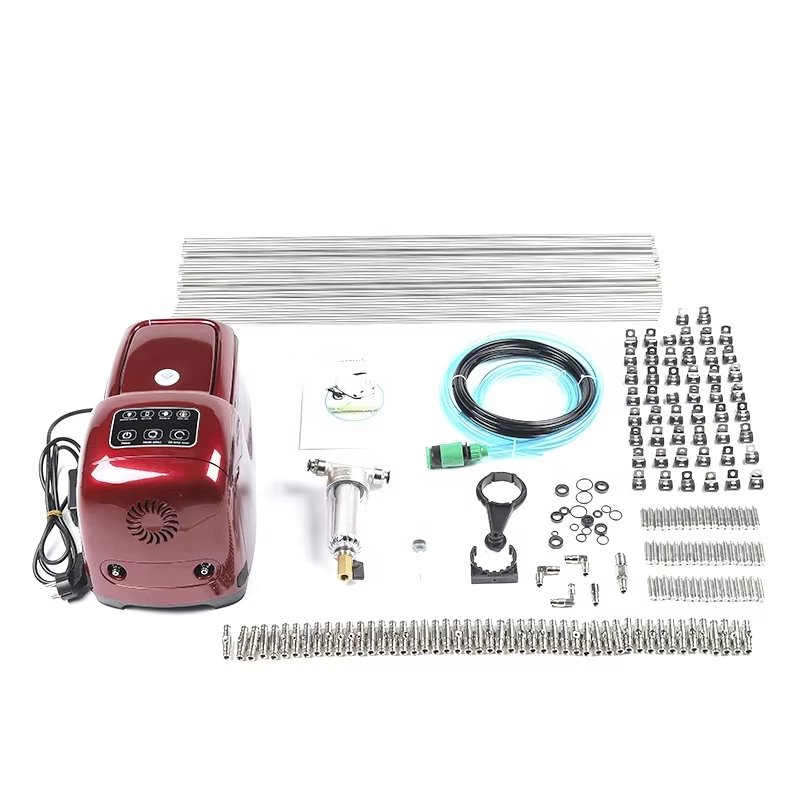
High-Pressure Pump: The Heart of the Misting System
The high-pressure pump generates 800–1,000 PSI, essential for efficient atomization. Industrial-grade models use stainless steel or brass components to endure continuous operation, boosting municipal water pressure (typically 40–60 PSI) to levels that enable flash evaporation. At 1,000 PSI, water is reduced to 5–10 micron droplets optimal for rapid heat absorption without surface wetting.
Micro-Nozzles and Tubing: Delivering Consistent Fine Mist
Engineered nozzles with orifice diameters of 0.004–0.008 inches produce ultra-fine mist when paired with corrosion-resistant stainless steel tubing or UV-stabilized polymer lines. This combination ensures reliable droplet distribution in demanding outdoor environments. To maintain performance, manufacturers recommend replacing nozzles every 2–3 seasons to prevent mineral buildup from degrading mist quality.
Integration with Misting Fans for Enhanced Air Distribution
Misting fans spread those tiny water droplets much better than just letting them hang around. When paired with axial fans that have weatherproof motors, these systems can actually cut down on heat quite a bit, sometimes dropping temps by about 25 degrees Fahrenheit. Restaurant owners love this setup for their outdoor seating areas because it keeps things cool without making everyone feel damp or uncomfortable. The airflow from the fans helps distribute moisture evenly so no one spot gets too humid while others stay dry. Plus, customers tend to stick around longer when they're not sweating through their clothes at lunchtime.
Cooling Performance and Real World Efficiency Metrics
Temperature Drop Potential: Up to 25°F Reduction in Seconds
These high pressure misting systems can actually cool things down between 10 to maybe even 25 degrees Fahrenheit pretty quickly, usually within about half a minute or so. When we're talking about really dry areas where the relative humidity is under 60%, those tiny water droplets measuring around 5 to 10 microns just soak up all that hidden heat hanging around in the air. Some folks did a study last year published in Applied Thermal Engineering, and they saw temperatures drop nearly 18 degrees during their experiments outside. Pretty interesting stuff too because these numbers match up pretty well with what people are seeing out there in actual desert environments, though conditions do vary based on local factors like wind speed and sun exposure.
Case Study: Commercial Patio Cooling With Measurable Results
A restaurant patio in Phoenix, Arizona, lowered peak afternoon temperatures from 104°F to 82°F using a high-pressure misting system, consuming just 2 gallons of water per hour per nozzle. Over a 90-day trial:
- 68% reduction in heat-related customer complaints
- 22% increase in average table occupancy
- 9% lower water usage compared to low-pressure alternatives
Comparative Energy and Water Efficiency vs. Traditional AC Systems
Misting systems actually cut down on energy usage by around 85 to 90 percent compared to regular air conditioners when it comes to cooling outside spaces, something the Department of Energy has confirmed through their tests. What makes them so efficient is that they ditch those big compressors and chemical refrigerants altogether, relying instead on simple water evaporation right where people need it most. Take a space of about 1,000 square feet for example these systems typically only draw around 1.5 kilowatt hours each day. That's pretty amazing when we compare it to portable AC units which can guzzle anywhere from 15 to 20 kWh daily. The difference adds up fast in places where saving electricity matters a lot, like commercial properties or large public areas looking to reduce their power bills without sacrificing comfort.
Design and Environmental Factors Influencing System Effectiveness
Impact of Climate: Optimal Performance in Hot, Dry Conditions
Peak efficiency occurs in arid climates (below 40% humidity), where rapid evaporation can reduce temperatures by up to 25°F. In humid environments (above 70% RH), saturated air limits evaporation, diminishing both immediate and sustained cooling effects.
Strategic System Design Based on Airflow, Sun Exposure, and Space Layout
Optimal performance requires designs tailored to environmental conditions:
| Design Element | Optimization Strategy | Performance Benefit |
|---|---|---|
| Airflow Patterns | Nozzles aligned with prevailing winds | +30% mist dispersion efficiency |
| Sun Exposure | Focus misting on heat-absorbing surfaces | Enhances evaporation rate by 20% |
| Space Layout | Limit tubing runs to ¥20 ft with wide-radius bends | Reduces pressure loss by 18% |
Proper nozzle spacing and pipe sizing prevent water pooling and ensure even cooling coverage, as demonstrated in system design research.
Smart Features: Timers, Sensors, and Automation in Modern Systems
Modern systems integrate humidity sensors and programmable controllers that adjust mist output in real time. These smart features reduce water consumption by 22–35% compared to manual setups while maintaining consistent cooling under fluctuating conditions, improving sustainability and user comfort.
Table of Contents
- The Science of Evaporative Cooling in High-Pressure Misting Systems
- High Pressure Operation at 1000 PSI: Enabling Instant Flash Evaporation
- Core Components of a High Pressure Misting System
- Cooling Performance and Real World Efficiency Metrics
- Design and Environmental Factors Influencing System Effectiveness