
How High Pressure Misting Systems Work: Components and Core Functionality
Core Mechanism of the High Pressure Misting System in Commercial Disinfection
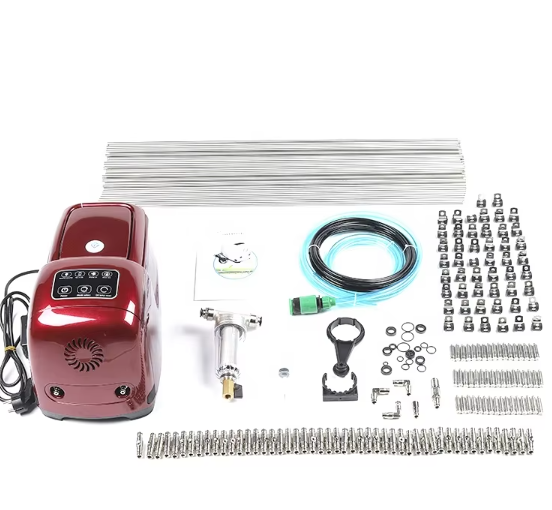
High pressure misting systems clean big commercial areas by pushing water through specially designed nozzles operating around 1000 to 1500 psi. This creates a fine mist that spreads EPA-approved disinfectants onto surfaces and into the air itself. At the heart of these systems sits the pump, which boosts fluid pressure to roughly 20 to 30 times what regular plumbing handles. This extreme pressure allows for even distribution throughout various facilities like warehouses, medical centers, and food production sites where thorough sanitation is critical.
Ultra-Fine Droplet Generation (10-Micron) and Its Impact on Pathogen Neutralization
The system produces droplets averaging 10 microns in diameter, small enough to remain airborne for extended periods and penetrate microbial contaminants. Due to their high surface-area-to-volume ratio, these droplets maximize contact with pathogens, achieving 99.9% inactivation when paired with effective disinfectants, as demonstrated in controlled efficacy studies.
Pump Specifications (1000—1500 psi) and Nozzle Precision (.008—.012 Orifice)
Industrial-grade pumps maintain consistent pressure between 1,000—1,500 psi, while brass or stainless-steel nozzles feature orifices sized .008—.012 inches to control flow. This ensures optimal atomization, with each nozzle delivering 0.5—2 gallons per hour, balancing chemical efficiency and full-area coverage.
Water Filtration and Clog Resistance: Ensuring System Longevity
A three-stage filtration process—including 5-micron sediment filters and inline UV sterilization—prevents mineral buildup and biofilm formation. In hard water environments (≥7 gpg), quarterly filter replacement is critical; neglecting maintenance can lead to 74% efficiency loss, according to water quality benchmarks (AquaTech 2024).
Fogging vs. Misting: Effectiveness in Air and Surface Disinfection
Differentiating Misting and Fogging Technologies in Pathogen Control
The main difference between high pressure misting and traditional fogging lies in the size of the droplets they create and how these get applied. Misting systems produce those super tiny droplets ranging from about 5 to 30 microns using special nozzles operating at pressures around 1,000 to 1,500 psi. These small particles evaporate quickly but stay suspended in the air long enough to provide ongoing disinfection benefits. Traditional fogging works differently though, creating bigger droplets typically between 30 and 100 microns that fall onto surfaces pretty fast for direct contact cleaning. Healthcare professionals often warn about using uncontrolled fogging methods in medical environments because the coverage tends to be uneven according to CDC infection control standards. On the flip side, many industrial operations and food processing plants have started embracing misting technology instead since it offers better balance between air and surface disinfection needs.
Role of Droplet Size in Airborne and Surface Disinfection Efficiency
Droplet size significantly impacts performance:
- Airborne pathogens: Misting’s 10-micron droplets remain suspended for 15—30 minutes, enabling prolonged chemical exposure and faster microbial reduction—up to 50% quicker than fogging.
- Surface coverage: Fogging achieves 85—90% surface coverage within 5—10 minutes but requires more disinfectant. Field data shows it reduces surface recontamination by 28% in warehouse environments (Pest Control Science, 2023).
This balance makes misting ideal for dynamic environments requiring both air and surface pathogen control.
Case Study: 92% Reduction in Surface Contamination in a Food Processing Facility
In a recent study at a chicken processing facility during 2023, researchers looked at how often fogging worked versus using an automatic high-pressure misting system to tackle Salmonella problems. What they found was pretty impressive: the misting approach cut down surface germs by nearly 92% over half a year, which beats the fogging method by about 20%. Plus, it used 35% less cleaning chemicals overall. Why did this work so well? The system spread out tiny 12-micron droplets consistently across surfaces. They also had smart humidity sensors that stopped things from getting too wet, something many facilities struggle with. And nobody had to worry about blocked nozzles since there was a fine 5-micron filter catching debris beforehand. These findings back up what OSHA has been pushing since 2024 about needing better-controlled droplet delivery systems in places where food safety is critical.
High Pressure Misting vs Electrostatic Spraying: A Performance Comparison
Atomization Principles in High Pressure Misting System Operation
High pressure misting works through mechanical atomization, typically employing pumps that run between 1000 to 1500 psi along with nozzles sized around 0.008 to 0.012 inches. These components create those tiny droplets measuring under 10 microns. What makes this hydraulic method special is how it can wrap around all sorts of objects, even covering vertical walls and ceilings, without needing any kind of electrical charge involved. Since there are no charged particles floating around, cleaning becomes much easier and there's less chance of leaving behind stubborn residues. This matters a lot in places where hygiene standards matter most like food processing areas or medical facilities that need to stay spotless at all times.
Electrostatic Misting: Charged Particle Coverage vs Physical Dispersion
Electrostatic sprayers work by giving disinfectant droplets a positive charge so they stick better to surfaces that are negatively charged. This makes them really good at covering tricky spots like the nooks and crannies of equipment or around electronic components where regular spraying might miss. But there's a catch. The charged particles lose their grip after about 6 to 8 feet away from the sprayer, which means operators have to get pretty close to what needs cleaning. That's quite a bit shorter than the high pressure misters that can reach out 15 to 20 feet without losing much power. Another thing worth mentioning is that both types of sprayers need clean water going through them. If the water has lots of minerals in it, those tiny nozzles start getting clogged over time, which nobody wants when trying to maintain consistent coverage during cleaning operations.
Coverage, Contact Time, and Chemical Efficiency: Benchmarking Both Methods
Tests in actual warehouse settings reveal that high pressure misting covers surfaces at around 98% efficiency within just half an hour, which beats the 89% coverage rate achieved by electrostatic spraying during the same period. On the flip side, those tiny electrostatic droplets actually stick around about 22% longer on things like fabric or wood because they bond through electrical charges. Both techniques can cut down on chemical usage when the droplet sizes are properly adjusted, saving anywhere from 50% to 70% compared to old-fashioned manual spraying methods. The real advantage of high pressure systems though comes down to their ability to run non-stop without worrying about batteries dying, something that makes all the difference for factories needing round-the-clock protection against contaminants.
Maintenance and Optimization for Reliable Commercial Use
Nozzle and Filter Selection Based on Environmental Demands
Getting good results really comes down to picking parts that work well with what's going on around them. When it comes to nozzles, their hole size matters a lot too. Most folks find that somewhere between .008 and .012 inches works best depending on how dirty the water is and what kind of stuff needs cleaning out. Plants dealing with hard water problems (over 150 parts per million minerals) tend to do better with stainless steel filters since they stand up against mineral buildup so much better. And for those places where there's lots of harsh chemicals floating around, PTFE coated nozzles last way longer than regular ones. A recent study back in 2023 showed that when companies get this right, they end up spending about 40 percent less time fixing things in tough spots like meatpacking facilities or dairy operations.
Routine Maintenance to Prevent Downtime in High-Traffic Facilities
To sustain peak performance, operators should conduct biweekly nozzle inspections and quarterly pump servicing. Daily conductivity testing helps detect mineral accumulation in continuous-use settings. Data from manufacturing maintenance reports indicate that replacing diaphragms every 800 operating hours cuts unplanned downtime by 67% in round-the-clock operations.
Water Efficiency and System Integration Best Practices
Today's misting systems save around 30 percent on water usage thanks to pumps that regulate flow and smart sensors that tweak output based on actual conditions. When these systems connect to building management software, they work hand in hand with HVAC units to keep indoor humidity levels under 60% relative humidity. This matters because too much moisture reduces how well disinfectants actually work. Checking system pressure once a year is also important since even small leaks above 5 psi can become big problems. In larger facilities, such leaks might end up wasting more than 15 thousand gallons every month just sitting there unnoticed.
Beyond Disinfection: Air Quality Benefits of High Pressure Misting Systems
Dual Functionality: Odor Control and Dust Suppression in Industrial Settings
High pressure misting systems do more than just tackle pathogens; they also make the air better by cutting down on bad smells and keeping dust under control. Food processors and waste management operations have found that these tiny water droplets actually break apart those VOCs that cause nasty odors in the workplace. At the same time, the fine mist grabs onto floating particles in the air, which cuts down on dust levels quite a bit. Some studies show reductions between 40% to 60% depending on how the air moves around. For businesses, this means meeting OSHA requirements becomes easier while workers enjoy a much cleaner environment overall. Many facilities report fewer complaints from staff about respiratory issues after installing these systems.
Integrated Solutions: Misting Systems in Smart HVAC and Building Management
More buildings these days are combining misting systems with smart HVAC technology to better handle indoor air quality issues. The system works by monitoring PM levels through sensors. When it notices particles going up, it automatically starts cleaning cycles to maintain PM2.5 at around 12 micrograms per cubic meter, which is actually 35 percent below what the EPA considers safe. Another important feature is how these systems avoid making the air too moist, something that can mess with proper disinfection processes. Facilities managers who have installed these integrated systems tell us they're seeing between 15 and 30 percent improvements in how efficiently their climate control systems run compared to just using regular ventilation alone. This kind of performance makes a strong case for why connected misting solutions represent a good investment for building operators looking to cut costs while maintaining healthy environments.
Table of Contents
-
How High Pressure Misting Systems Work: Components and Core Functionality
- Core Mechanism of the High Pressure Misting System in Commercial Disinfection
- Ultra-Fine Droplet Generation (10-Micron) and Its Impact on Pathogen Neutralization
- Pump Specifications (1000—1500 psi) and Nozzle Precision (.008—.012 Orifice)
- Water Filtration and Clog Resistance: Ensuring System Longevity
- Fogging vs. Misting: Effectiveness in Air and Surface Disinfection
- High Pressure Misting vs Electrostatic Spraying: A Performance Comparison
- Maintenance and Optimization for Reliable Commercial Use
- Beyond Disinfection: Air Quality Benefits of High Pressure Misting Systems